Nojoqui Falls

(written for and rejected by an online travel site—too long—back in late 90’s.)

Rural California seemed to start with Goleta in the rearview mirror. Driving north out of Santa Barbara on Highway 101, there is a long, gorgeous stretch between mountains and shore, where the elongated Santa Barbara plain is reduced to just a sliver of farmland and undeveloped beach. Eventually it is too narrow even for the fields, and civilization just tapers off into nothingness. Just the road, sea and mountains.

The last vestige of the plain comes to an abrupt end at Gaviota, where the 101 makes a veer to the true north from its western course along the South Coast. A winding pass permits passage through the wall of the Santa Ynez mountains (one of those Transverse ranges, erupting when plates collide and causing so much seismic mischief in the LA Basin). To the burro riding padres of Father Serra’s world this must have seemed a more gradual—if more arduous—transition, but in a speeding car the change is sudden and stunning. The narrow walls of the defile reveal a whole other world of crags and dense oak forests. The mountains are stark, untamed; the slopes impenetrable. Signs warn of falling rocks and wild beasts. We sped up the long grade, at the top of which was a truck pullover, where a battered orange sign announced “Nojoqui Park”. Curiosity got the best of me and I veered off.

Once off the highway, we were plunged immediately into the primeval forest. An ancient, narrow road, cracked and sundered, twisted its way round slopes beneath the trees. The air was dark, almost creepy, penetrated only feebly by rays of sunlight. Birds flushed in all directions. We had the near instantaneous feeling of being lost, only minutes off the 101. Round we wound, down and down, till at last we were dumped into a sparkling green valley. We parked along side a rotting wooden fence to stretch our legs and snap some pictures. Birds called from all directions and a rabbit darted at our feet. We walked about a bit, listening and watching. We were completely on our own in this tiny, beautiful valley. I had no idea where this Nojoqui Park—or even what—would be, but if it were anything as beautiful as this then we were in for a treat. Back in the car, my wife studied the county map and found Nojoqui Falls. Now our curiosity was truly piqued, and we followed the old road, which in a few minutes seemed to lead us right through a farm, past barn and aging machinery. A right turn eventually led us to the park. As if out of nowhere, there were crowds of people about, seemingly hundreds of them, and animals—cows, pigs, sheep and goats by the score. We had stumbled onto a gathering of the Buellton 4H club. Fortunately there was plenty of parking under the pines where the trail began. It was a very gradual uphill walk of perhaps three-quarters of a mile, alongside the gurgling stream, round trees and over rocks, some laid out stepwise. Squirrels chattered in the branches. The weather had turned cool, cloudy and was threatening rain, and in these coastal canyons you could still feel the dampness of the morning’s fog.

Suddenly, the narrow canyon opened up and the sounds of the creek were swallowed in the rush of falling water. Ahead towered Nojoqui Falls. A good 80 feet in height, its grandeur was not in the volume of water tumbling over but the cathedral-like patterns of its fall. The rock upstream, it seems, is an easily soluble limestone while the falls themselves tumble over much harder granite. Over the eons evaporating mists have left their mineral mark and built up layers of limestone in the very shape of the Falls themselves, and then the water, in its turn erodes patterns anew and falls in the most perfectly graceful gestures. A perpetual motion machine of water and rock and air, Nojoqui Falls shall continue its slow, inexorable growth until the limestone that lines the stream above is eroded away completely. There was a bench and we sat and watched the water flow through its ancient etchings. It seemed such a shame that we had left the camera behind in the car. We had the binoculars, though, and through them observed flycatchers and bluebirds flitting in the branches above. I walked down to the pool and reached in elbow deep. The water was cold, clear. The footing slippery. We sat and watched and listened. The mist wafted into our faces. Who knows for how long people have come to this place tucked back in the mountains to watch and listen. Who knows what spiritual significance this place held for the local Chumash Indian civilization. Indeed, that such a splendid and rare natural phenomenon has remained but a county park is one of bureaucracy’s little mysteries—though Santa Barbara County has done an excellent job maintaining the site (and providing the geologic information on these very peculiar falls). The urge to remain just a little bit longer was powerful. But for us time was pressing. Places to go, reservations to keep. We tracked back to the car, slowly. The sound of falling water faded behind us. Squirrels rattled about in the trees and the sun was breaking through.

Back in the parking lot all was a bustle of competition. Walking past the car I wandered down to the 4H pens, where kids in their green ties and caps gently prodded their hogs around before the judges. Those reservations would hold a few minutes longer. I watched, applauding, and took in the sweet reek of pig.
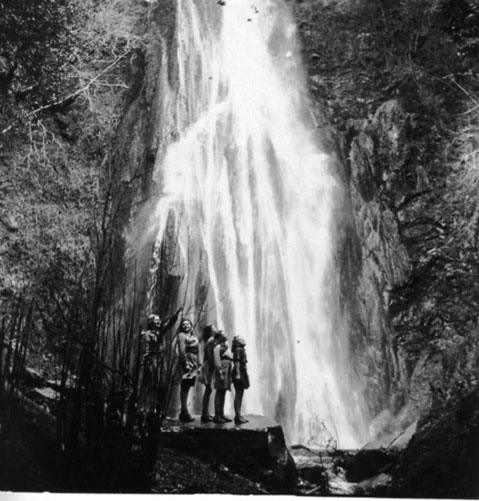
Nojoqui Falls

Nojoqui Falls

Los Angeles 1982-83

(1982 journal entry)

I like to stand on a freeway overpass as the sun sets onL.A.The car river at my feet flows to and fro, whirring metal slivery silvery in the escaping light. Behind me, ringing round, the mountains block all retreat between foothills and the fire spreading across the sea. City lights twitter on. Growing and shrinking cars open their eyes yellow and red. I feel the tire-treaded asphalt’s hum. I hear the composite little bangs of cylinders going fast and furious. Smell their farts. Turn round toward the inky profile where mountains had been and let the Santa Anas dryly slap my face: tear ducts rush to compensate and the coming yellow eyed going red eyed river becomes a pinkish smudge cutting though the hills. As watery fires subside to the west, the land here sparkles with signs of life, shining its challenge to the suns above.

“Carpe diem” I say. Seize the day. Seize the fucking day!


(this next one is from Sam Eisenstein’s Creative Writing class at L.A. City College, 1983…interesting piece, but I was way off in  that third paragraph, though I was probably reflecting the view of the time, which back then still didn’t know just what to make of the Los Angeles Metropolitan area.)

Los Angeles works when it moves. The common denominator of all those who hope to succeed inL.A.is movement. To move is to make it, to cease moving is to be left out: if not dead, then useless. And if useless, then as good as dead. The whole metropolis surges back and forth with movement. When a part of the city is in the process of change, it lives, and when not it is decaying. There is no such thing as a thriving old neighborhood in this city-when a section gets old and its population grows old-it is doomed. The sons and daughters do not hang around to inherit the old man’s business-they move somewhere else and start their own. The bustling town of twenty, even ten years ago is hardening, growing old, slowing up. What were the outlying “sticks” of a decade before are now building indoor shopping malls, sprouting tracts of homes, and widening the old streets in anticipation of the inexorable reach of urban sprawl.

It is in these places, on the hillsides and within the once secluded valleys even beyond the rim of the Los Angeles Basin, that one can witness the incredible phenomenon of “ghost” streets. Self-contained networks of narrow, apparently residential streets, some ending in cul-de-sacs, others leading into the scrub and the inevitable tangle of Motocross trails. Each one is paved, man-holed, sidewalked and addressed, and marked by numbered street signs, laying in the middle of open fields occupied by no one but ground squirrels. They are named after some kind of thing, by groups: Flowers, for instance, or lakes or states, or Spanish names that begin with “el” or “los”. They give no clue as to whether they were ever inhabited or are waiting for inhabitants. They simply sit there, an empty, windy, and somehow ghostly reminder of a catastrophe that never happened.

We know of course that they are tracts of homes planned but waiting for investors. Yet in walking through the sage and around the tumbleweeds choking the cul-de-sacs, startling the skittish ground squirrels (and probably being watched by the hawks soaring above), one gets an inevitable sense of foreboding: a vaguely chilling feeling that this is the future of Los Angeles. It is hard to think of the reason-a solid physical reason-thatL.A., huge sprawling L.A., exists at all. There is no great harbor (wrong), it is not a large agricultural region (wrong), nor the hub of a large network of trade routes (wrong), or sit atop a commanding site on a river. It is not a capital nor a religious center, nor a center of any ancient traditions. And it is not built up around an industrial core (there are virtually no giant industrial complexes here….but all kinds of light industry, not to mention the movie studios).

Rather it is a collection point for a national whim to move west, away from it all, the magnet for people desperate to make it in the movies. It is an opportunity to make a fast buck, and go home again, richer. It is a collecting point for those who like warmth. Los Angeles is the end result of a national whim: the so-called frontier impulse, but really just the itch to move. It is the end of the road.

Los Angeles’ foundations are shakey:  raised on the shifting sands of human migratory tendencies, that is people’s urge to get out and make something of themselves. And when, and if, Southern California can no longer serve that need, it could shrivel up and disappear. It has happened before, for various reasons, to other great cities: Carthage stormed, razed and sown with salt by the conquering Romans.Palmyra, whose fabulous ruins lay awash in the sands, the victim of changing trade routes. Ma’rib, capital of the biblical Sheba, destroyed when a deluge washed away its water supply. Mighty Rome, for a great part of its history, was reduced to a few thousand fever-ridden inhabitants when the surrounding swamps filled once more. And in our country, dozens of towns and cities have faded or disappeared with the end of a boom, change of sovereignty, diversion of a river, or because the residents just got tired of living there. It could happen again, here, to Los Angeles.

But the thought is really of no concern to us. We are an existential populace, making the fast buck in a historical vacuum. Carpe Diem. Our traditions, are folklore are those of change and movement: pre-fabricated housing, the automobile, the freeway, the instant millionaire. But it is worth considering, if only for the sheer hell of it, that those phantom neighborhoods of windblown houseless streets could be a vision of the skeletal remains of Los Angeles in a post-deluvian future. Of Los Angeles, in both idea and reality, if indeed the two can be separated.

For those wonderful freeways that bring people to Los Angeles with such speed and directness; then, once they are here, bind them together into the incongruous mass calledLos Angeles, can, with the same uninterrupted speed and directness lead them away.

Last night words kept me up

(2010)

Last night words kept me up, some piece coming together that I couldn’t shake.  It developed paragraph by unwritten paragraph inside my skull till finally it completed itself and let me sleep after 2 in  the fucking morning. That happens a lot. When my med levels are off it happens more. I dreamed another story, dreamed I was writing it, till it woke me around 5 am. I laid there sleepy with this fucking story going through my head. A ridiculous 5 am story…I never use 5 am stories. Men are crazy at 5 am. Maybe you’ve noticed.

No writing  today, nothing. No emails today, but this one. Hopefully no stories tonite. I wish I knew why that happens, but it’s always happened. Just words, man. It’s like I’m practicing. Working things out. Well, not me practicing, but it, the language. It sits up there in our brain, an actual thing, and it sometimes make us do things that not to our advantage. This isn’t LSD talking…it’s actually neuro-linguistic theory, one rather difficult to grasp. .It’s just too weird. Anyway, this language thing gets stirred all up in there round that hole in my brain in the Broca’s region and doesn’t give a flying fuck about what the rest of the body needs, or wants. Namely sleep. But tonite I sleep. I promise.

I’ve heard of musicians tormented by the music in  their heads. It’s the same thing, I bet. The music being created incessantly and the poor bastard whose brain contauins it wishes it wasn’t there. Creativity, it’s wildly overrated.

Anyway I have more to do before I go home. Then I watch a hockey game and we order a pizza and drink beer and talk and I go to sleep.

Grand Canyon

The Grand Canyon is such an amazing place, and at any of the scenic views, all of which are at the edge of the abyss (and it is an abyss), there’s this feeling of death that never leaves until you are safely back in the car. I imagine that is part of the attraction of the park, there’s a thrill to it. I think we’re all terrified by the notion that on some crazy impulse we didn’t even know we had, we would hurl ourselves over.  I think that’s what takes hold of a few people every year. As they fall they wonder just what the hell made them do such a crazy thing.

My god, what an unsettling thought that is.