Los Angeles 1982-83

(1982 journal entry)

I like to stand on a freeway overpass as the sun sets onL.A.The car river at my feet flows to and fro, whirring metal slivery silvery in the escaping light. Behind me, ringing round, the mountains block all retreat between foothills and the fire spreading across the sea. City lights twitter on. Growing and shrinking cars open their eyes yellow and red. I feel the tire-treaded asphalt’s hum. I hear the composite little bangs of cylinders going fast and furious. Smell their farts. Turn round toward the inky profile where mountains had been and let the Santa Anas dryly slap my face: tear ducts rush to compensate and the coming yellow eyed going red eyed river becomes a pinkish smudge cutting though the hills. As watery fires subside to the west, the land here sparkles with signs of life, shining its challenge to the suns above.

“Carpe diem” I say. Seize the day. Seize the fucking day!


(this next one is from Sam Eisenstein’s Creative Writing class at L.A. City College, 1983…interesting piece, but I was way off in  that third paragraph, though I was probably reflecting the view of the time, which back then still didn’t know just what to make of the Los Angeles Metropolitan area.)

Los Angeles works when it moves. The common denominator of all those who hope to succeed inL.A.is movement. To move is to make it, to cease moving is to be left out: if not dead, then useless. And if useless, then as good as dead. The whole metropolis surges back and forth with movement. When a part of the city is in the process of change, it lives, and when not it is decaying. There is no such thing as a thriving old neighborhood in this city-when a section gets old and its population grows old-it is doomed. The sons and daughters do not hang around to inherit the old man’s business-they move somewhere else and start their own. The bustling town of twenty, even ten years ago is hardening, growing old, slowing up. What were the outlying “sticks” of a decade before are now building indoor shopping malls, sprouting tracts of homes, and widening the old streets in anticipation of the inexorable reach of urban sprawl.

It is in these places, on the hillsides and within the once secluded valleys even beyond the rim of the Los Angeles Basin, that one can witness the incredible phenomenon of “ghost” streets. Self-contained networks of narrow, apparently residential streets, some ending in cul-de-sacs, others leading into the scrub and the inevitable tangle of Motocross trails. Each one is paved, man-holed, sidewalked and addressed, and marked by numbered street signs, laying in the middle of open fields occupied by no one but ground squirrels. They are named after some kind of thing, by groups: Flowers, for instance, or lakes or states, or Spanish names that begin with “el” or “los”. They give no clue as to whether they were ever inhabited or are waiting for inhabitants. They simply sit there, an empty, windy, and somehow ghostly reminder of a catastrophe that never happened.

We know of course that they are tracts of homes planned but waiting for investors. Yet in walking through the sage and around the tumbleweeds choking the cul-de-sacs, startling the skittish ground squirrels (and probably being watched by the hawks soaring above), one gets an inevitable sense of foreboding: a vaguely chilling feeling that this is the future of Los Angeles. It is hard to think of the reason-a solid physical reason-thatL.A., huge sprawling L.A., exists at all. There is no great harbor (wrong), it is not a large agricultural region (wrong), nor the hub of a large network of trade routes (wrong), or sit atop a commanding site on a river. It is not a capital nor a religious center, nor a center of any ancient traditions. And it is not built up around an industrial core (there are virtually no giant industrial complexes here….but all kinds of light industry, not to mention the movie studios).

Rather it is a collection point for a national whim to move west, away from it all, the magnet for people desperate to make it in the movies. It is an opportunity to make a fast buck, and go home again, richer. It is a collecting point for those who like warmth. Los Angeles is the end result of a national whim: the so-called frontier impulse, but really just the itch to move. It is the end of the road.

Los Angeles’ foundations are shakey:  raised on the shifting sands of human migratory tendencies, that is people’s urge to get out and make something of themselves. And when, and if, Southern California can no longer serve that need, it could shrivel up and disappear. It has happened before, for various reasons, to other great cities: Carthage stormed, razed and sown with salt by the conquering Romans.Palmyra, whose fabulous ruins lay awash in the sands, the victim of changing trade routes. Ma’rib, capital of the biblical Sheba, destroyed when a deluge washed away its water supply. Mighty Rome, for a great part of its history, was reduced to a few thousand fever-ridden inhabitants when the surrounding swamps filled once more. And in our country, dozens of towns and cities have faded or disappeared with the end of a boom, change of sovereignty, diversion of a river, or because the residents just got tired of living there. It could happen again, here, to Los Angeles.

But the thought is really of no concern to us. We are an existential populace, making the fast buck in a historical vacuum. Carpe Diem. Our traditions, are folklore are those of change and movement: pre-fabricated housing, the automobile, the freeway, the instant millionaire. But it is worth considering, if only for the sheer hell of it, that those phantom neighborhoods of windblown houseless streets could be a vision of the skeletal remains of Los Angeles in a post-deluvian future. Of Los Angeles, in both idea and reality, if indeed the two can be separated.

For those wonderful freeways that bring people to Los Angeles with such speed and directness; then, once they are here, bind them together into the incongruous mass calledLos Angeles, can, with the same uninterrupted speed and directness lead them away.
Last night words kept me up

(2010)

Last night words kept me up, some piece coming together that I couldn’t shake.  It developed paragraph by unwritten paragraph inside my skull till finally it completed itself and let me sleep after 2 in  the fucking morning. That happens a lot. When my med levels are off it happens more. I dreamed another story, dreamed I was writing it, till it woke me around 5 am. I laid there sleepy with this fucking story going through my head. A ridiculous 5 am story…I never use 5 am stories. Men are crazy at 5 am. Maybe you’ve noticed.

No writing  today, nothing. No emails today, but this one. Hopefully no stories tonite. I wish I knew why that happens, but it’s always happened. Just words, man. It’s like I’m practicing. Working things out. Well, not me practicing, but it, the language. It sits up there in our brain, an actual thing, and it sometimes make us do things that not to our advantage. This isn’t LSD talking…it’s actually neuro-linguistic theory, one rather difficult to grasp. .It’s just too weird. Anyway, this language thing gets stirred all up in there round that hole in my brain in the Broca’s region and doesn’t give a flying fuck about what the rest of the body needs, or wants. Namely sleep. But tonite I sleep. I promise.

I’ve heard of musicians tormented by the music in  their heads. It’s the same thing, I bet. The music being created incessantly and the poor bastard whose brain contauins it wishes it wasn’t there. Creativity, it’s wildly overrated.

Anyway I have more to do before I go home. Then I watch a hockey game and we order a pizza and drink beer and talk and I go to sleep.

John Turturro

[from the last ever Brick’s Picks in the LA Weekly]

Just saw John Turturro’s Passione and talk about a revelation. We barely knew anything about Neapolitan music. Dean Martin, Lou Canova, pizza parlor juke boxes…that’s about it. Who knew that back in ancient, messed up, photogenic Naples was the real thing.  Not even the hippest radio stations played the stuff. That bothered Turturro. He loves this music. So he did one of those things that must drive Hollywood agents utterly mad…he took a film crew over there and shot 23 songs by 23 different acts in 23 different locations in 21 days and man, you gotta see the results. There isn’t a performance that isn’t stellar…the passion and intensity is so stirring you’d have to be a hardened cynic not to be moved. The tunes run the artistic gamut from street singers to classic love songs to art songs to operatic numbers to a very Neapolitan rap, rock and even reggae. Even a couple flat out weird numbers. Turturro limits himself on screen to a couple street interviews (and one freaky dance); mostly he just narrates, sparingly. He doesn’t edit the tunes all to hell and no story line bogs the thing down. It’s just music and locations and people…no heavy analysis, no dreadful music critics, and unlike Buena Vista Social Club, no American musicians sit in and taint everything. Nope. This is the best music flick we have seen since Calle 54, and to be honest, we liked this even more. Go see it. Buy the soundtrack. You’ll be making pasta and singing “O Sole Mio” to your dog, and that’s not necessarily a bad thing.

Musician?

Musician? I’m a musician now? Where did that come from? I mean, I played drums for years, yeah, but I was one of those drummers for which the term musician was quite a stretch…. I didn’t even know Don Heckman knew about that.

Had fun, though. Girls, drugs, parties. Not to mention tearing down on stage as the next band is trying to set up and my guitarist is backstage somewhere doing something fun or illegal.

Oh, and the violence, bar room brawls, a night in jail, kicked over drum kits, getting dusted and playing with my hands (a lotta blood), taking on a dozen cops (they won), a lot of funerals (none my own), turning down a chance to be a porn star (I love that story), who knows what else. A helluva lotta fun.

But it never once occurred to me to call myself a musician.

Of course, how I became a jazz critic I will never understand either. It wasn’t my idea. Nice perks, tho’. Plus you get all kinds of jazz credibility without having to be a, well, musician.

Heckling

Heckling’s a lost art. Back in my punk rock days being heckled meant they liked you. Unless they heckled because they didn’t like you. It was a subtle distinction. Same with the beers thrown at you…if they threw them unopened it could mean they were tossing you a beer, a good thing. Then again, the first punk show I ever saw the opening act—some completely bogus glitter bunch who tore their jeans for the occasion—were bombarded first with empties, then with half fulls that made cool beer arcs as they sailed through the air, and finally with unopened cans because they could actually hurt. The band was that bad. One well aimed can knocked over a ride cymbal and they fled for their lives.

I came back to my pad back then thinking this shit was soooo cool, better than all the miserable post hippie sell out rock or mewling singer-songwriters or disco or the jazz players in ludicrous side burns playing loud fusion crap. I was ready for some craziness. Everything sucked in 1977. Everything. If you were young and broke—and who wasn’t by 1977—you were fucked. No future, Johnny Rotten sang, no future for you. He wasn’t kidding.

A couple years later, having become a lousy but spirited and sometimes violent drummer,  there was a show once where a we were pelted with beer bottles (which was a good thing at this show…since we were trying to bring the crowd to the edge of rioting—-don’t ask why, but it made sense at the time)…and I managed to nail an airborne bottle with a stick and it shattered into a shower of golden shrapnel. Alas the rest of the band was in the way. But that was punk rock.

And there was the time I kicked over the kit at the set’s end—I kicked over my kits  many times, loved it—and remembered as the drums crashed and bounced across the stage that, ummm,  it wasn’t my kit. It was the short little fuck of a drummer who we’d intimidated into letting me use it. We’d kinda stormed the stage. Had enough of that shitty new wave band. Hated new wave bands.

Man, we were assholes in them days. Ha! Punk rock, baby. Fuck ’em if they can’t take a joke. That, by the way, was my wife’s slogan. No wonder I fell head over heels for her. Later, after seeing Repo Man, she added “Normal people, I hate ’em.” She did too.

How I wound up a jazz writer I’ll never know.

Grand Canyon

The Grand Canyon is such an amazing place, and at any of the scenic views, all of which are at the edge of the abyss (and it is an abyss), there’s this feeling of death that never leaves until you are safely back in the car. I imagine that is part of the attraction of the park, there’s a thrill to it. I think we’re all terrified by the notion that on some crazy impulse we didn’t even know we had, we would hurl ourselves over.  I think that’s what takes hold of a few people every year. As they fall they wonder just what the hell made them do such a crazy thing.

My god, what an unsettling thought that is.

Ghidorah

Tonight (10/4/04) – Kerry benefit: GHIDORAH hard rock fiesta

Ghidorah are my favorite rock band now.  They shred.  They rocked so hard and out I had no idea they were covering a King Crimson song and therefore could not respond intellectually.  They do great old Cream songs that gets Bob Moss really excited.  Vince plays drums and he even sings just like the dude in Rare Earth.  Carey’s out there boing/screech chunka chunka chicken headed guitar generated a ten minute long Curly Joe imitation by Cake.  They once played completely naked except for three very rare English prog 45’s they found on Ebay for a lot of money.  They will scare all the conservatives, confuse all the liberals, and ignore the Naderites.  The Natural Law people will understand, though.  They generated more dope smoking among the audience than any pop group since The Five Man Electrical Band blew Miles Davis off the stage at Watkin’s Glen.  And as an added treat, Pat Hoed does the worst Johnny Winter impression I have ever seen. 

They certainly qualify as groovy.

First car

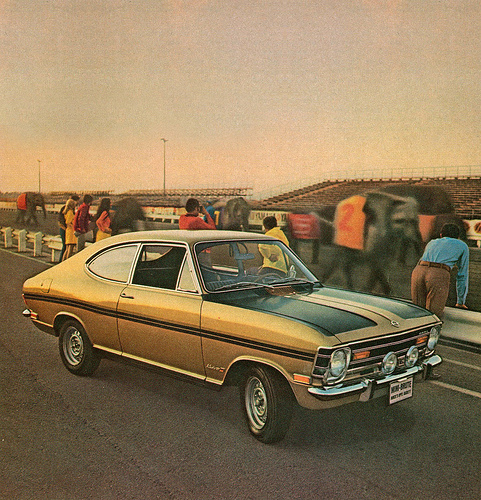
I learned to drive a standard transmission when I bought my buddy’s Opel for $350. Think it was a ’68 coupe. Amazing car. Too small to fuck in, but you could grow a crop of corn in the shag carpeting. Which I did.

A '68 Buick Opel Kadett. Mine was canary yellow.

A ’68 Buick Opel Kadett. Mine was canary yellow.

Carmageddon

Help.

I’m stuck in traffic on the 2 freeway, two days now on the bridge over the Los Angeles River. Carmageddon. Drivers have given up and abandoned their vehicles, roving gangs are robbing and killing, I haven’t seen a highway patrol officer in days. All I can hear is gunfire, wailing and illegal aliens. All I can see are the smoldering ruins of a dead civilization. Situation desperate. Running out of food, water and air. Can someone send help?

Just don’t take the 405.

Brick

Barstool

Two tecates and lunch at the bar of Don Cucos, watching the bartender shake tequila silly, and all the problems of the world go away.  I was gloriously all by myself. Didn’t have to answer one inane question from coworkers or reporters or musicians or anybody. Just me, the bartender, and some leggy, stacked blonde on the channel nine news hired for her meteorological skills.